
Saturday, November 12, 2011
Watching Harry Potter to the Glory of God


Tuesday, May 24, 2011
Why Bob Didn't Call It a Snake
Here's a post I wrote on Bob Dylan's 70th Birthday about his song "Man Gave Name to All the Animals":
http://russreaves.blogspot.com/2011/05/why-bob-didnt-call-it-snake.html
http://russreaves.blogspot.com/2011/05/why-bob-didnt-call-it-snake.html
On Appreciation for the Art of a Pagan
Here's a post I wrote over on my other blog about how Christians can (and actually DO) appreciate the art produced by non-Christian artists: http://russreaves.blogspot.com/2011/05/on-appreciation-for-art-of-pagan.html
Saturday, July 11, 2009
Truth is Stranger than Stranger Than Fiction
 (Spoiler Alert: This is not a film critique or review. It contains spoilers, giveaways about the major twists of plot and ending to the film. If you haven't seen it, and don't want me to ruin it for you, stop reading here. If you have seen it, don't plan on seeing it, or don't care about it being ruined, then read on.)
The old adage, "Truth is stranger than fiction," is so time-worn that it is nearly cliche. The story that is told in the film "Stranger than Fiction" is also time-worn, but will never be cliche. It is a story about a man who is going to die, but he doesn't know he's going to die. But then in a bizarre sort of way learns that he is going to die. And knowing that he is going to die changes the way he lives. OK, that part is cliche. It has even found its way into a country music song, confirming its cliche-ness. But there is more to this story. In fact, there is an old, old story that is written between the lines of this screenplay.
The film is billed as a comedy, and with Will Ferrell in the lead role one may expect that slapstick and sophomoric humor which has made him famous (not to mention wealthy). While the film is funny and lighthearted throughout, there are moments which do not feel comic at all. In one ironic scene, Harold Crick (played by Ferrell) learns the difference between comedy and tragedy from Professor Jules Hilbert (played by Dustin Hoffman): "In a tragedy you die, in a comedy you get hitched."
Karen Eiffel (played by Emma Thompson) is a renowned novelist with a decade long case of writer's block. Harold Crick is a tax auditor with a case of life block that is probably even longer. But the two develop a symbiotic relationship when Eiffel begins unknowingly telling Crick's story, and Crick can hear her telling it in his head. Crick learns from the narrator in his head that he is going to die. He doesn't know when or how, but is determined to figure out the mystery. When he meets Eiffel face-to-face, he pleads with her to change the ending, leaving her perplexed. Upon reading the first draft, Professor Hilbert claims that it mustn't be changed because it is the masterpiece of her stellar career. Crick must die just in the way that Eiffel has narrated.
Long story short, Crick doesn't die the way she narrated. In fact, he doesn't die at all. Oh sure, the events unfold just as she originally penned. Crick throws his life in front of a moving bus to save the life of a young boy. Viewers, like the bystanders on the curb, are certain that he is dead. Moments later, the scene shifts to the hospital where Crick is recovering in traction.
Herein is the Truth that is stranger than fiction. We are living out a grand story, a metanarrative being told by a Third-Person Omniscient. It is God's story. He knew how it would end before it began. And in God's story, the hero is not Crick but Christ. Like Eiffel's story in which Crick must die, in God's story Christ must die. But neither are tragedies in the end. For starters, both "died" sacrificially, laying their lives down to save another. Crick laid his life down in front of the bus to save the helpless boy in the street. Christ laid his life down on the cross to save helpless sinners. And secondly, death does not have the final word in either story. After meeting Crick, Eiffel changed the ending to her story. Crick in fact did not die, but received a second chance at a fulfilled life and a romantic love. Christ did die, but His death was not the end. Through His glorious resurrection He lives, offering all who come to Him a second chance at abundant life and divine love. God never changed the end of His story. The hero had to die, but death would be swallowed up in victory.
Upon reading the revised manuscript, Professor Hilbert asks Eiffel, "Why did you change the book?"
She responds, "Lots of reasons. I realized I just couldn't do it."
Hilbert questions, "Because he's real?"
And Eiffel states, "Because it's a book about a man who doesn't know he's about to die, and then dies. But if the man does know he's going to die and dies anyway, dies, dies willingly knowing he could stop it, then, I mean, isn't that the type of man you want to keep alive?"
After reading of his own death, Crick finds Eiffel on the street one evening and says, "It's lovely ... I read it, and I loved it, and there's only one way it can end. ... This seems simple enough. I love your book, and I think you should finish it." In other words, Crick has seen the way he will die, and he accepts it, knowing that it is a good way to go out, a poetic and beautiful way for his life to end, and that the result of his death will be great success for the author.
God's story, like Eiffel's is about a Man who is going to die. He knows He is going to die. He accepts the reality of His imminent death and says to the Author of His story, "It's lovely ... I read it, and I loved it, and there's only one way it can end. ... This seems simple enough. I love Your book, and I think You should finish it." In other words, Christ has seen the way He will die, and He accepts it, knowing it is a beautiful way to go out, laying His life down for sinners. And He knows the result will not be a Pulitzer Prize for the Author of His story, but glory (Compare John 17:1 and Hebrews 12:2 to what Crick said on the street). He knows He's going to die, and dies anyway, dies willingly knowing He could stop it. And He is in fact alive today, risen from death. Isn't He the type of Man, the type of God-Man, you want to be alive? He is. This is not fiction. It is stranger than that. It is Truth (John 14:6).
Tuesday, February 03, 2009
Green Grass and High Tides
When it comes to music, the sky is the limit. I can dig everything from Gregorian Chants to New Wave; from Bach to Bachman Turner Overdrive. This rather large repertoire of music preferences makes any list on my iPod a bit of an oddity to the average consumer of music. One exercise in which I engage is to discover music or lyrics that have, either intentionally or unintentionally, a spiritual theme.
One song that I haven't been able to get out of my head of late is the classic rock song, Green Grass and High Tides, by Southern Rock band, The Outlaws. Contrary to popular belief, the song is NOT about marijuana use. The term, "green grass," in the title gave rise to this unfortunate rumor. Outlaws member, Henry Paul, explains the song's lyrics here.
Personally, the song reminds me of visions of a restored universe and eternity with Jesus Christ and the saints. Consider the lyrics:
In a place you only dream of
Where your soul is always free
Silver stages, golden curtains
Filled my head, plain as can be
As a rainbow grew round the sun
All the stars I've loved who died
Came from somewhere beyond the scene you see
These lovely people played just for me
Now if I let you see this place
Where stories all ring true
Will you let me past your face
To see what's really you
It's not for me to ask these questions
As though I were a king
For you have to love, believe and feel
Before the burst of tambourines take you there
Green grass and high tides forever
Castles of stone souls and glory
Lost faces say we adore you
As kings and queens bow and play for you
Those who don't believe me
Find your souls and set them free
Those who do, believe and love
As time will be your key
Time and time again I've thanked them
For the peace of mind
They helped me find myself
Amongst the music and the rhyme
That enchants you there
Green grass and high tides forever
Castles of stone souls and glory
Lost faces say we adore you
As kings and queens bow and play for you
Yeah, they play just for you
Billy Belk
Tuesday, November 25, 2008
Anyone Want to Get Expelled? Anyone? Anyone?
 Are you tired of liberals being the only ones who make "in your face" documentaries? Me too. That is why I was so excited about Ben Stein's film "Expelled." Two can play at this game, and Ben has raised the stakes.
I did not see this film in the theaters, because frankly I do not enjoy going to theaters to see movies. I know, I am goofy, and I don't even own one of those whopper TVs that make the images larger than life. But I prefer watching films in my own home, in my comfortable chair where I have plenty of room and where I can talk in audible levels to my companions and eat whatever I want without being charged a week's pay for a snack. I also like having beverages in containers which are actually sized for the human hand to hold and being able to pause the movie when I need to. So for all these reasons, DVDs are for me. I rented it from Netflix, and then immediately purchased a copy of it so I can loan it out to others and watch it repeatedly. I also wanted to support the filmmakers and the organization from which I purchased it, Answers in Genesis.
I should say up front that I do not endorse the cut and paste tactics of contemporary documentaries. I know that some important material invariably ends up on the cutting room floor, and I am sure that Expelled's critics are being accurate when they say that statements were included out of context and selectively arranged to further the point of the filmmaker. I am also not an advocate of slippery-slope arguments, which this film certainly employs. But at least in this case, the shoe was on the other foot and the tactics were employed to further a far different cause than in Michael Moore's or Al Gore's films. Funny that critics did not seem so adamant about these same concerns when those films came out.
I will also lay all my cards on the table here. I am a 6-literal day, young earth Creationist, and unashamed to say so. I know that labels me as a neanderthal in the minds of some, but I do not lose sleep over their judgment of me. I prefer to prioritize what God thinks of my handling of His word. I may never be asked to teach in a secular university because of those views, but I would rather maintain my convictions with a clear conscience than to be conformed by the patterns of this world's thinking. A professor friend once told me that although he believed the text of Genesis lends itself to a 6-literal day, young earth interpretation, he could not hold that position because it would ruin his academic credentials. I think that is a crying shame, because on all accounts this was stated by a top-notch scholar.
Expelled is not a propaganda piece for young-earth Creationism. It is not even an attempt to prove the truth of Intelligent Design. Ben Stein is not a Christian, and it is fair to say that he is probably not a young-earther. Rather, in Expelled, Stein sets out to uncover a bias against all anti-Darwinian approaches to the study of origins in higher education. This is done by interviewing scholars who have lost their credentials because of their commitment to alternative explanations of origins and interviewing those who are leading the charge of the New Atheism like Richard Dawkins.
Undoubtedly influenced by his Jewish heritage, Stein demonstrates how Darwinian thinking has fueled the most horrid attrocity in recent human history: the Holocaust. It would be a slippery slope to argue that every Darwinian is pro-Hitler. While I would not want to go so far as to say that all Darwinians espouse genocide, the film helps viewers to see how this kind of thinking makes such tragedies possible, and in fact greatly influenced it in one historic case.
The real issue at stake in Expelled is academic freedom. This is a touchy subject for many. After all, Southern Baptists have not exactly been poster children for academic freedom. During the conservative resurgence, professors were fired from SBC seminaries for teaching doctrines contrary to the Baptist Faith & Message. However, these institutions are confessional schools, which are entrusted by the denomination to train up leaders for its constituent churches. Within the rather broad confines of the Baptist Faith and Message, there is room for much diversity in the classroom. In my courses at one of the SBC seminaries, I had professors who held to a variety of positions on many issues. Not all were young-earth creationists; not all were of a particular school of thought when it comes to Calvinism or Arminianism; etc. But there is and should be some expectation that professors in confessional schools will not teach contrary to the confession of faith that they have been consituted to uphold. However, most secular universities do not have a confessional basis, and therefore, each professor's work should be allowed to stand or fall on their own merits. Expelled even indicts Baylor, a historically Baptist college, for disallowing the teaching of anti-Darwinian theories.
I would recommend this film to anyone who is interested in origins, Darwinism, and Intelligent Design, as well as those who are involved as teachers, administrators and students in higher education. My hope is that it will embolden a new generation of scholars to stand up for their own convictions and publish well-defended scholarly works that uphold the integrity of Scripture and refute Darwinian evolution. I also hope that this film will spawn others to go public with their own experiences of educational biases, and raise an outcry against such hypocritical narrow-mindedness. Regardless of our presuppositions or commitments, education should always stand in opposition to such.
Monday, July 21, 2008
Tangled Up in Dylan, Part 4: Cry a While

This is one of those songs that has to be heard; reading the lyrics don't do it justice. It typifies the "new" Dylan sound of his later releases. This will be the last installment of "Tangled Up in Dylan" for a while, so jump into the comments and share some thoughts on the lyrics:
Well, I had to go down and see a guy named Mr. Goldsmith
A nasty, dirty, double-crossin', back-stabbin' phony I didn't wanna have to be dealin' with
But I did it for you and all you gave me was a smile
Well, I cried for you - now it's your turn to cry awhile
I don't carry dead weight - I'm no flash in the pan
All right, I'll set you straight, can't you see I'm a union man?
I'm lettin' the cat out of the cage, I'm keeping a low profile
Well, I cried for you - now it's your turn, you can cry awhile
Feel like a fighting rooster - feel better than I ever felt
But the Pennsylvania line's in an awful mess and the Denver road is about to melt
I went to the church house, every day I go an extra mile
Well, I cried for you - now it's your turn, you can cry awhile
Last night 'cross the alley there was a pounding on the walls
It must have been Don Pasquale makin' a two a.m. booty call
To break a trusting heart like mine was just your style
Well, I cried for you - now it's your turn to cry awhile
I'm on the fringes of the night, fighting back tears that I can't control
Some people they ain't human, they got no heart or soul
Well, I'm crying to The Lord - I'm tryin' to be meek and mild
Yes, I cried for you - now it's your turn, you can cry awhile
Well, there's preachers in the pulpits and babies in the cribs
I'm longin' for that sweet fat that sticks to your ribs
I'm gonna buy me a barrel of whiskey - I'll die before I turn senile
Well, I cried for you - now it's your turn, you can cry awhile
Well, you bet on a horse and it ran on the wrong way
I always said you'd be sorry and today could be the day
I might need a good lawyer, could be your funeral, my trial
Well, I cried for you, now it's your turn, you can cry awhile
Copyright © 2001 Special Rider Music
Columbia Records
Tangled Up in Dylan, Part 3: Property Of Jesus

Here I offer up for discussion the lyrics of the 1981 "Shot of Love" single, "Property of Jesus":
Go ahead and talk about him because he makes you doubt,
Because he has denied himself the things that you can't live without.
Laugh at him behind his back just like the others do,
Remind him of what he used to be when he comes walkin' through.
He's the property of Jesus
Resent him to the bone
You got something better
You've got a heart of stone
Stop your conversation when he passes on the street,
Hope he falls upon himself, oh, won't that be sweet
Because he can't be exploited by superstition anymore
Because he can't be bribed or bought by the things that you adore.
He's the property of Jesus
Resent him to the bone
You got something better
You've got a heart of stone
When the whip that's keeping you in line doesn't make him jump,
Say he's hard-of-hearin', say that he's a chump.
Say he's out of step with reality as you try to test his nerve
Because he doesn't pay no tribute to the king that you serve.
He's the property of Jesus
Resent him to the bone
You got something better
You've got a heart of stone
Say that he's a loser 'cause he got no common sense
Because he don't increase his worth at someone else's expense.
Because he's not afraid of trying, 'cause he don't look at you and smile,
'Cause he doesn't tell you jokes or fairy tales, say he's got no style.
He's the property of Jesus
Resent him to the bone
You got something better
You've got a heart of stone
You can laugh at salvation, you can play Olympic games,
You think that when you rest at last you'll go back from where you came.
But you've picked up quite a story and you've changed since the womb.
What happened to the real you, you've been captured but by whom?
He's the property of Jesus
Resent him to the bone
You got something better
You've got a heart of stone
Copyright © 1981 Special Rider Music
Tangled Up in Dylan, Part 2: Shelter from the Storm

In the comments section, I hope we can get a good discussion going on about the lyrics posted below. "Shelter from the Storm" was first released on the 1975 "Blood on the Tracks."
'Twas in another lifetime, one of toil and blood
When blackness was a virtue and the road was full of mud
I came in from the wilderness, a creature void of form.
"Come in," she said,
"I'll give you shelter from the storm."
And if I pass this way again, you can rest assured
I'll always do my best for her, on that I give my word
In a world of steel-eyed death, and men who are fighting to be warm.
"Come in," she said,
"I'll give you shelter from the storm."
Not a word was spoke between us, there was little risk involved
Everything up to that point had been left unresolved.
Try imagining a place where it's always safe and warm.
"Come in," she said,
"I'll give you shelter from the storm."
I was burned out from exhaustion, buried in the hail,
Poisoned in the bushes an' blown out on the trail,
Hunted like a crocodile, ravaged in the corn.
"Come in," she said,
"I'll give you shelter from the storm."
Suddenly I turned around and she was standin' there
With silver bracelets on her wrists and flowers in her hair.
She walked up to me so gracefully and took my crown of thorns.
"Come in," she said,
"I'll give you shelter from the storm."
Now there's a wall between us, somethin' there's been lost
I took too much for granted, got my signals crossed.
Just to think that it all began on a long-forgotten morn.
"Come in," she said,
"I'll give you shelter from the storm."
Well, the deputy walks on hard nails and the preacher rides a mount
But nothing really matters much, it's doom alone that counts
And the one-eyed undertaker, he blows a futile horn.
"Come in," she said,
"I'll give you shelter from the storm."
I've heard newborn babies wailin' like a mournin' dove
And old men with broken teeth stranded without love.
Do I understand your question, man, is it hopeless and forlorn?
"Come in," she said,
"I'll give you shelter from the storm."
In a little hilltop village, they gambled for my clothes
I bargained for salvation an' they gave me a lethal dose.
I offered up my innocence and got repaid with scorn.
"Come in," she said,
"I'll give you shelter from the storm."
Well, I'm livin' in a foreign country but I'm bound to cross the line
Beauty walks a razor's edge, someday I'll make it mine.
If I could only turn back the clock to when God and her were born.
"Come in," she said,
"I'll give you shelter from the storm."
Copyright © 1974 Ram's Horn Music
Tangled Up in Dylan, Part 1: It Ain't Me Babe

Jump into the comments and let's discuss what's going on in this song, first released on "Another Side of Bob Dylan" (1964):
Go 'way from my window,
Leave at your own chosen speed.
I'm not the one you want, babe,
I'm not the one you need.
You say you're lookin' for someone
Never weak but always strong,
To protect you an' defend you
Whether you are right or wrong,
Someone to open each and every door,
But it ain't me, babe,
No, no, no, it ain't me, babe,
It ain't me you're lookin' for, babe.
Go lightly from the ledge, babe,
Go lightly on the ground.
I'm not the one you want, babe,
I will only let you down.
You say you're lookin' for someone
Who will promise never to part,
Someone to close his eyes for you,
Someone to close his heart,
Someone who will die for you an' more,
But it ain't me, babe,
No, no, no, it ain't me, babe,
It ain't me you're lookin' for, babe.
Go melt back into the night, babe,
Everything inside is made of stone.
There's nothing in here moving
An' anyway I'm not alone.
You say you're looking for someone
Who'll pick you up each time you fall,
To gather flowers constantly
An' to come each time you call,
A lover for your life an' nothing more,
But it ain't me, babe,
No, no, no, it ain't me, babe,
It ain't me you're lookin' for, babe.
Copyright © 1964; renewed 1992 Special Rider Music
Tangled Up in Dylan: Introduction
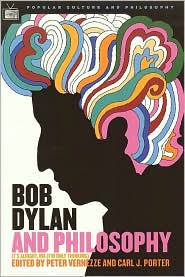
I have just finished reading Bob Dylan and Philosophy, edited by Peter Vernezze and Carl J. Porter, an installment in Open Court's "Popular Culture and Philosophy" series. Having read several volumes in this series, I found this one to be more engaging than the others. It seems to be truer to philosophical issues and to the subject (Dylan, in this case) than the other volumes I have read. Reading it has plunged me into the world of Dylan's music once again. I have gone through several "Dylan-phases" in my life, preferring earlier works, later works, acoustic works, electric works, at various points in the journey. Now I find myself enthralled by it all: the songs I resonate with, the songs I don't, and the ones I don't get (and there are plenty of them).
In the following several posts, I am going to paste some Dylan lyrics, and offer no commentary in the post. But what I would like to do is open the comments for a discussion on what is going on in the lyrics. Also, in the comments, if there are specific Dylan works you want to explore, suggest them and it will be done.
Thursday, June 19, 2008
A Pastor's Anthem: I Won't Back Down
Over ten years ago, the students of Fruitland Baptist Bible Institute were treated to a concert by Southern Gospel group Gold City on the campus. I still remember hearing them say that a well-known pastor who was undergoing much publicized trials and tribulations in ministry began every day listening to their song, "I'm Not Giving Up." The song goes like this:
I'm not giving up. I'm not turning 'round.
By the grace of God I'll win a shining crown someday.
I'll keep holding on to that nail-scarred hand.
I'm not giving up, no I'll keep going on.
Been walking through the valley
Through this vale of tears
At times I've even questioned even if my Lord was near
Then at times that ole' tempter says "Why not turn around?
You can't get any farther, because you're just losing ground."
I'm not giving up. I'm not turning 'round.
By the grace of God I'll win a shining crown someday.
I'll keep holding on to that nail-scarred hand.
I'm not giving up, no I'll keep going on.
Would you mind to tell me; there's been something botherin' me:
Why is it that ole' devil, he just won't let God's children be.
See he has purposed and determined to get right in the way
And turn us from the way of life
And lead our souls astray.
I'm not giving up. I'm not turning 'round.
By the grace of God I'll win a shining crown someday.
I'll keep holding on to that nail-scarred hand.
I'm not giving up, no I'll keep going on.
When I heard that song and the accompanying testimony, I was naive about the challenges of ministry. I thought, "My goodness, how bad can it be that someone would have to begin every day with that affirmation?" But soon enough, my idealism met the reality that is pastoral ministry. It is tempting, especially on Mondays and Thursdays to say, "Why don't I just throw in the towel?" And I just don't like Southern Gospel music enough to make myself listen to that song every day. But then along comes Tom Petty.
Who knew that Tom Petty was so sensitive to the concerns of Pastoral Ministry? Last night, on a late night run to Chic-Fil-A, "I Won't Back Down" popped up in the shuffle on my iPod. Maybe its because it was business meeting night, maybe its because several people took the liberty to try to tell me how I should preach and teach, maybe its because I spent a good deal of time talking with someone about the difference between doing "what's right" in ministry rather than doing "what works," or any number of other reasons (maybe I was just really tired), but this song came across to me as one that could have been (or maybe should have been) written by a pastor who is plugging along as faithfully as he can in spite of many obstacles. It could just as easily apply to a faithful Christian trying to follow the call to discipleship and witness in a fallen world. What I like about Petty's song is that (for understandable reasons) it does not force us to see Satan behind every attack. Sometimes "the world" (as the term is used often in Scripture to denote the ways of thinking that dominate this world) is our enemy. People, even church people, even pastors, are influenced by the world. And the one who tries to live hard for God will be dragged down and pushed around by the world. And there isn't any easy way out. "Pie in the sky" will only get you so far on a Monday or Thursday. We're better to remember the words of Petty: "There ain't no easy way out." Sometimes it just takes raw determination to say, "I won't back down," in the face of the gates of hell and the threats of this world.
"I Won't Back Down" by Tom Petty
Well I won't back down
No I won't back down
You could stand me up at the gates of Hell
But I won't back down
No I'll stand my ground
Won't be turned around
And I'll keep this world from draggin' me down
Gonna stand my ground
And I won't back down.
Hey, baby. There ain't no easy way out.
Hey yeah, I will stand my ground.
And I won't back down.
Well I know what's right
I got just one life
In a world that keeps on pushin' me around
But I'll stand my ground
And I won't back down.
Hey, baby. There ain't no easy way out.
Hey yeah, I will stand my ground.
And I won't back down.
Hey, baby. There ain't no easy way out.
Hey yeah, I won't back down
Hey, baby. There ain't no easy way out.
Hey yeah, I will stand my ground
And I won't back down.
I'm not giving up. I'm not turning 'round.
By the grace of God I'll win a shining crown someday.
I'll keep holding on to that nail-scarred hand.
I'm not giving up, no I'll keep going on.
Been walking through the valley
Through this vale of tears
At times I've even questioned even if my Lord was near
Then at times that ole' tempter says "Why not turn around?
You can't get any farther, because you're just losing ground."
I'm not giving up. I'm not turning 'round.
By the grace of God I'll win a shining crown someday.
I'll keep holding on to that nail-scarred hand.
I'm not giving up, no I'll keep going on.
Would you mind to tell me; there's been something botherin' me:
Why is it that ole' devil, he just won't let God's children be.
See he has purposed and determined to get right in the way
And turn us from the way of life
And lead our souls astray.
I'm not giving up. I'm not turning 'round.
By the grace of God I'll win a shining crown someday.
I'll keep holding on to that nail-scarred hand.
I'm not giving up, no I'll keep going on.
When I heard that song and the accompanying testimony, I was naive about the challenges of ministry. I thought, "My goodness, how bad can it be that someone would have to begin every day with that affirmation?" But soon enough, my idealism met the reality that is pastoral ministry. It is tempting, especially on Mondays and Thursdays to say, "Why don't I just throw in the towel?" And I just don't like Southern Gospel music enough to make myself listen to that song every day. But then along comes Tom Petty.
Who knew that Tom Petty was so sensitive to the concerns of Pastoral Ministry? Last night, on a late night run to Chic-Fil-A, "I Won't Back Down" popped up in the shuffle on my iPod. Maybe its because it was business meeting night, maybe its because several people took the liberty to try to tell me how I should preach and teach, maybe its because I spent a good deal of time talking with someone about the difference between doing "what's right" in ministry rather than doing "what works," or any number of other reasons (maybe I was just really tired), but this song came across to me as one that could have been (or maybe should have been) written by a pastor who is plugging along as faithfully as he can in spite of many obstacles. It could just as easily apply to a faithful Christian trying to follow the call to discipleship and witness in a fallen world. What I like about Petty's song is that (for understandable reasons) it does not force us to see Satan behind every attack. Sometimes "the world" (as the term is used often in Scripture to denote the ways of thinking that dominate this world) is our enemy. People, even church people, even pastors, are influenced by the world. And the one who tries to live hard for God will be dragged down and pushed around by the world. And there isn't any easy way out. "Pie in the sky" will only get you so far on a Monday or Thursday. We're better to remember the words of Petty: "There ain't no easy way out." Sometimes it just takes raw determination to say, "I won't back down," in the face of the gates of hell and the threats of this world.
"I Won't Back Down" by Tom Petty
Well I won't back down
No I won't back down
You could stand me up at the gates of Hell
But I won't back down
No I'll stand my ground
Won't be turned around
And I'll keep this world from draggin' me down
Gonna stand my ground
And I won't back down.
Hey, baby. There ain't no easy way out.
Hey yeah, I will stand my ground.
And I won't back down.
Well I know what's right
I got just one life
In a world that keeps on pushin' me around
But I'll stand my ground
And I won't back down.
Hey, baby. There ain't no easy way out.
Hey yeah, I will stand my ground.
And I won't back down.
Hey, baby. There ain't no easy way out.
Hey yeah, I won't back down
Hey, baby. There ain't no easy way out.
Hey yeah, I will stand my ground
And I won't back down.
Wednesday, April 09, 2008
In the Presence of the Lord: Clapton's God

Slowhand himself would quickly refute the author of this graffiti. And he would take no offense to what this dog is doing to the graffiti-emblazoned wall. He might even join the dog. That's the impression I get of Clapton from reading this interesting feature by CT's John Powell about the spiritual side of Eric Clapton. It is an interesting read, though it stops short of saying what some of us would hope to read in such an article.
One correction -- Powell says, "the man whose work with a Gibson Les Paul." Clapton is not known for playing a Les Paul, but rather a Stratocaster. I think every picture I've ever seen of him depicts him with a Strat. What would otherwise be a compelling article is somewhat diminished by such an obvious error on the writer's part.
Rare picture of Clapton with a Les Paul (notice the body of the guitar is only cut away on the bottom, and a switch is on the top):

Typical images of Clapton with a Strat (notice the double cut away of the guitar's body):


Friday, February 15, 2008
California Dreamin'
Stumbled upon a post today by Michael A. G. Haykin, History Professor at Southern Seminary, about his personal reflections on The Mamas and The Papas' song, "California Dreamin'."
Powered by ScribeFire.
Wednesday, January 30, 2008
Architecture Revisited
Several of my posts here have addressed the often overlooked artform of architecture. Maybe it is because I used to love playing with Legos (Used to? I still do!), or because at one time I entertained notions of being an architect. Mostly, though, I think it is because of my disdain for contemporary church architecture that I find myself ruminating on the subject nowadays. Slate Magazine brings us this article about avant-garde architecture that is dotting the skylines of Arab nations and China.

It is an interesting phenomenon that Slate brings to mind -- the inability of humans to predict the future of cultural expressions. Undoubtedly, these buildings are influenced by at least three underlying desires: 1) the desire to be different; 2) the desire to be futuristic; 3) the desire to escape the bounds of the current status quo. However, what is often overlooked in these ventures is that if everyone desires to be different, then everyone ends up being the same. The person who is truly different is the one who doesn't mind "playing by the rules." So, buildings with classical architectural features are always more awe-inspiring than the "avant-garde" because we value the "sameness" that the architect was willing to preserve in his design. Also, when one examines the attempts of previous generations to be "futuristic" one sees a laughable product of ignorant prognostication which in fact never came to pass. For the best illustration of this, one only needs to watch an old re-run of the Jetsons to see what the creative minds of bygone days thought our century would look like. Across the world, designs that portended to be futuristic in their day dot the landscape, mostly being an eyesore. Some at best are nostalgic reminder of a former generations hopes and dreams. Finally, how does one escape the status quo when the status quo is escaping the status quo? This is the problem of postmodernism. If everyone gets to invent their own rules, their own "truth," their own categories, then how does one truly find a way to revolt against it? A simple suggestion -- we must return to objective reality and objective Truth (with a capital "T").
Perhaps Witold Rybczynski, the writer of Slate's article "Don't Count Your Titanium Eggs Before They've Hatched: Why Architects Can't Predict the Future" is trying to make the same point when he concludes the article with this statement: "The real question about new buildings should never be 'Are they cutting edge?' but 'Are they good?'" If we are left to live in a society without norms, without objectivity, without objective standards, then we will not be able to answer the question about something's goodness.
Powered by ScribeFire.
Thursday, January 24, 2008
C. S. Lewis, Augustine and the Silver Bullet Band


Augustine famously wrote, "Thou hast made us for Thyself, and our hearts are restless until they rest in Thee." This statement has been conceptualized with the image of the God-shaped hole in the human heart. This image suggests that we have a "hole" in our heart that nothing else can fill except God Himself. We can attempt to fill that hole with other things -- personal relationships, hobbies, stuff, etc. -- but those things are incapable of filling the hole. The writings of C. S. Lewis are heavily laden with this concept, but Lewis does not speak of it in Augustine's terms. For Lewis, this "God-shaped hole" is experienced in the universal phenomenon of Sehnsucht. Literally translated, this German term means simply "desire," but the concept is much stronger than this English word conveys. I have written elsewhere a survey of this concept in Lewis's writings.
All of us have had the experience of disappointment. Disappointment occurs when something fails to live up to our expectations of it. We have our hopes set high that some new gadget will revolutionize our life, so we spend a lot of money to get that thing, only to find that it does not live up to the hype, or we break the thing, rendering it useless. We are left in despair. What we desire remains somewhere outside of our grasp. We could illustrate the concept of Sensucht another way. Phineas is offered a pill that promises to deliver a sensation of euphoria. Phineas takes this pill and experiences its "high." Wanting to repeat the experience, Phineas takes the pill again. In time, Phineas will discover that taking one of these pills does not deliver the same effects anymore, so he begins taking two at a time. He continues this until two no longer fulfill his desire, and he begins taking three, and so on. The ultimate experience of euphoria can never be attained, always lying somewhere just beyond the grasp.
Of course, for C. S. Lewis and for Augustine, God is the only answer to our Sehnsucht. Our hearts are restless, always seeking and never finding the rest we desire, until we rest in Him.
When one understands this, one holds in his or her grasp the answer to the questions often asked in popular expressions of art -- including popular music. This came to mind this morning as I listened to the song "Roll Me Away," by Bob Seger. Of course, I could use many other popular songs to illustrate the point (perhaps readers will share their own thoughts on this concept in the comment section).
In this classic rock power-ballad, Seger sings:
Took a look down a westbound road, Right away I made my choice. Headed out to my big two-wheeler, I was tired of my own voice. Took a bead on the northern plains And just rolled that power on.
Who among us hasn't wished we could just get away from it all? Tired of our surroundings, the daily grind, and even our own voices, we have a desire for escape. Seger takes off on his motorcycle, and one can feel the sense of liberation that comes over him as he rolls the power on.
Twelve hours out of Mackinaw City, Stopped in a bar to have a brew. Met a girl and we had a few drinks And I told her what I'd decided to do. She looked out the window a long, long moment, Then she looked into my eyes. She didn't have to say a thing, I knew what she was thinkin'.
You have to wonder what kind of desolate place he has come to if it can only be described as "twelve hours out of Mackinaw (or Mackinac) City. Surely he must be only a few hours away from another city he could name. And one would also question the wisdom of having a brew -- having "a few drinks" in fact -- before mounting his ride again, but I digress. As Seger shares a few drinks and bears his soul to a strange woman, he recognizes in her the same desire, though she need not say it. Of course she doesn't need to say it -- it is something every soul longs for. The look in her eyes said to Seger:
Roll, roll me away, Wont you roll me away tonight? I too am lost, I feel double-crossed, And I'm sick of what's wrong and what's right. We never even said a word, We just walked out and got on that bike. And we rolled -- And we rolled clean out of sight.
Lostness, betrayal, the burden of playing the game of life under someone else's rules. There must be something better out there somewhere. Let's go find it.
We rolled across the high plains; Deep into the mountains; Felt so good to me; Finally feelin' free.
Could it be that Seger has finally found the freedom he longs for? The buzz of alcohol, the wind in his face, a strange woman's arms around him, the beauty of creation all around. But alas, the sensation is short lived.
Somewhere along a high road, The air began to turn cold. She said she missed her home. I headed on alone.
It didn't take long for the woman to realize (or sober up enough to discover) that this adventure failed to live up to her expectations. She missed her home. You recall that "home" for her was a place of lostness, betrayal and a seeming unjust value system. But a few hours in the hot pursuit of something different -- something better -- did not deliver upon its promise. Better for her to return to the familiarity of her unpleasant reality than to keep pursuing the unknown on the back of Seger's bike. Seger doesn't tell us what he did with her. For all we know, he might have killed her. Let's assume he didn't. Did he leave her on the roadside to negotiate her own passage back to "twelve hours out of Mackinac City" or did he take her back himself? We will never know. But the open road still beckons Seger, and he headed on without his companion.
Stood alone on a mountain top, Starin' out at the Great Divide I could go east, I could go west, It was all up to me to decide. Just then I saw a young hawk flyin', And my soul began to rise. And pretty soon My heart was singin': Roll, roll me away, I'm gonna roll me away tonight.
Gotta keep rollin', gotta keep ridin', Keep searchin' till I find whats right. And as the sunset faded I spoke to the faintest first starlight. And I said, "Next time -- Next time we'll get it right."
One can almost feel the disappointment uttered in Seger's reluctant confession. He wants to experience the boundless freedom he sees in the flight of that young hawk over the Continental Divide. But alas, he won't find it on this journey. As the sun drops behind the mountains, Seger is left with the realization that, like the woman who abandoned the journey, he too must give up the quest and return to place from whence he came. But the desire will still be there, and he'll act upon it again. And "next time, we'll get it right."
The theme is familiar. You or I could have written this song, changing some of the details. But we have all found ourself lying in darkness uttering that reluctant confession -- "Next time, we'll get it right." The thing we so desire is just beyond our reach. And this will be the epilogue of all life's pursuits except one -- the pursuit of God. Only He can fill the hole. Only He can save us from our lostness. Only He will be faithful. Only He can remedy the betrayal we have experienced from others. Only He can right the wrongs. As we pursue Him, we will find Him (Jeremiah 29:13). Only in Him will we find the contentment for which we are all longing.
Seger says: "Just then I saw a young hawk flyin', And my soul began to rise."
Isaiah says: "Those who wait for the Lord will gain new strength; they will mount up with wings like eagles, they will run and not get tired, they will walk and not become weary." (Isa 40:31)
Thursday, September 06, 2007
Spy Kids 3: Game Over
Spoiler Alert: The following article contains a spoiler.
-----------------------------------------------------
I was called away from my little cave (aka: Pastor’s Study) to watch my two younger sons while my wife ran an errand. Still too hot in the middle of the day to go outside, my sons and I sat down to watch Spy Kids 3: Game Over on the Disney Channel.
The movie contained just enough animated special effects to keep the attention of a 4 and 2 year old and contained barely enough substance in its plot to keep the attention of a 38 year old dad. However, at the end of the movie, something amazing happened that I never expected.
The movie was heading toward the typical ending where the good guys overcome almost insurmountable odds to kick the butts of the bad guys. But at the very end, one of the good guys who seemed to have every right to enact revenge on the chief bad guy in the name of justice chooses not to do so. Rather, the two are reconciled.
I find it interesting that Dimension Films (which is not exactly a bastion of tameness when it comes to movie making) can produce a movie that ends with a message of forgiveness, redemption, and reconciliation which are all aspects of the gospel of Jesus Christ. I pray that I, as a member of the body of Christ, the Church, can illustrate Christ’s redemption in my own life as well as Dimension Films in Spy Kids 3.
Billy Belk
Thursday, July 05, 2007
National Treasure: Guest Feature by Dr. Larry Doyle
Dr. Larry Doyle is Director of Missions for the Piedmont Baptist Association in Greensboro, NC. Dr. Doyle included this article in his weekly "encourage_" email, and with his permission, I reprint it here. I told Dr. Doyle I felt like this piece was in keeping with the goals we established when we started this blog. Without further ado, here is Dr. Larry Doyle with "Our National Treasure."


This week our thoughts have turned to our nation, our history, and our future. As I was channel surfing this weekend, I caught the end of a Disney movie titled National Treasure. Watching this fictional story of a quest to discover, and protect the national treasure, made me ask the question, "Is there a real national treasure?"
My answer is yes, but I'm not thinking of a cache of gold, hidden somewhere beneath the streets of
If this is our treasure, what does it mean to trust in God?
The Bible says, "For God, who commanded the light to shine out of darkness, has shined into our hearts, to give the light of the glory of God in the face of Jesus Christ. But we have this treasure in an earthen vessel that the excellency of the power may be of God and not of ourselves." (2 Corinthians 4:6-7) The NLV says " . . .this precious treasure - this light and power that now shines within us - is held in perishable containers . . ."
In other words, our national treasure is our relationship with God, through Jesus Christ. In the movie, the national treasure was hidden in a tomb, beneath an old church in downtown
The code for rediscovering it, as the movie suggests, is not found in some ancient document written by men, such as the Declaration of Independence, but rather in God's Word. Further, we do not need "rose colored glasses" to see the hidden words, just the Holy Spirit to lead us to recognize the truth. We simply have to read the Word of God.
Just like in the movie, the path to encounter our treasure is also through a tomb. Someone paid the ultimate price for our treasure by giving His life. This tomb, however, is empty, because death could not hold Him there. His resurrection secured the treasure for us, and for everyone who believes in Him.
It is also important to remember, our treasure is intended to be shared with the world, not buried in our church buildings. Jesus said, "Go into all the world and preach the Good News to everyone, everywhere." Mark 16:15 NLV.
As citizens of perhaps the greatest nation in history, we do have a national treasure! Share the treasure! You can never give it away too many times! Tell someone about Jesus today!
Thursday, May 17, 2007
Good News for Movie Lovers

If you are a movie lover (as I am), then I can't encourarge you strongly enough to look into ClearPlay (which I discussed in a previous post entitled "Watching Movies Without Violating Your Conscience"). ClearPlay is a DVD player with a built-in software that "filters" objectionable content from most DVDs (see www.clearplay.com for a full list of movies; the list is expanding every day). The great news is that these DVD players are now available at Target stores, where you can buy them at a great savings over the ClearPlay website. What's more, the Target deal also includes the "Filter Stick" (a USB flash drive you use to download movie filters), a free trial membership to the filter subscription service, and over 2,000 filters (which I assume are pre-loaded onto the USB drive). So, if you love movies, head out to Target and get one of these things. We got ours from ClearPlay last fall, and now enjoy watching movies together as a family without worrying about what the kids (or adults!) will see or hear.
Wednesday, February 28, 2007
A Song That Points Us to God
Faithful readers of this blog (if there are any) will remember that our initial post here concerned a song written by Bob Dylan called "A Hard Rain's Gonna Fall." In that post, I talked about how that song drives more deeply to the heart of God than much of what we hear in contemporary Christian music, even (if not especially) that which is often mistakenly called "worship music." This gave us the title for the blog -- "The Sacred in the Secular." I can't speak for my S/S teammates here, but for me, the dichotomy is a bit artificial and often stretched. I believe that part of the image of God in us is an insatiable longing for Him. As Augustine said, "Thou hast made us for Thyself, and our hearts are restless until we rest in Thee." C. S. Lewis referred to this as sensucht. This comes across in our culture in the music, film, literature, and other arts of humanity. And often it comes through most clearly and certainly inadvertently in that which would be called "secular" by many evangelicals.
Last fall, I was exasperated because of a number of pressing frustrations I was dealing with. It caused me to have frequent paralyzing anxiety attacks, and produced bitterness and a crusty shell of lovelessness in my heart for others. I know all the verses, I have read all the books and heard all the sermons, but the fog would not lift. Yet, on Thanksgiving Day, I arose early to sit with my son for one of our annual traditions that I used to enjoy as a child with my father -- watching the parade on television. Anyone who has watched the parade for a number of years will know what I mean when I say that it has become more of a song and dance show than an actual parade. Usually that frustrates me. I want to see floats and balloons and marching bands. I don't want to see kick-lines and Broadway troupes and the stars of the new fall lineups. But I decided to endure a performance by Josh Groban. I had heard him sing before, and thought he had a tremendous voice and a good taste for timeless songs. On Thanksgiving Day, he sang a song called "You Are Loved (Don't Give Up)." And listening to the words of that song, I felt the embrace of God over me, and was lifted up from my despair to apply all those spiritual truths which I knew, but which I had ignored, avoided, and given up on during those stressful days.
Since that time, I have kept that song in the playlist on my iPod and find myself listening to it often. I am not a music video fan. I have never seen the music video for the song, and don't even know if one exists. But every time I listen to "You Are Loved," a series of images passes through my mind. These are the images I see on a near daily basis. I see the desperation on the streets around my church -- lives ruined by drug addiction, alcoholism, prostitution, mental illness. I find the scenes of families mourning at gravesides; lonely people lying in hospital beds on ventilators with no loved ones at their sides; people all around us trying to pretend to have it all together, when inside they are falling apart.
If I was to radically obey the words of the Apostle Paul when he says in Epehsians 5 that we are to be filled with the Holy Spirit, "speaking to one another in psalms and hymns and spiritual songs," then I would be pointing people to the 34th and 91st Psalms and singing these words to them and encouraging them to feel the loving embrace of their Father in Heaven as He comforts them with these promises. The singer isn't citing scripture, and I don't even know if the writer of the song had God in mind when he wrote it. But every promise in this song parallels a promise God has given us in His Word. As I copy the lyrics here, I will insert in parenthesis some of the places God has made these comforting promises of assurance to us:
Don't give up; It's just the weight of the world
When you're heart's heavy, I will lift it for you (1 Peter 5:7)
Don't give up; Because you want to be heard
If silence keeps you, I will break it for you (Matthew 10:19-20)
Everybody wants to be understood
Well I can hear you (Philippians 4:6-7)
Everybody wants to be loved
Don't give up
Because you are loved (Galatians 2:20)
Don't give up; It's just the hurt that you hide
When you lost inside, I will be there to find you (Luke 19:10)
Don't give up; Because you want to burn bright
If darkness blinds you, I will shine to guide you (Psalm 119:105; Matthew 5:14-16)
Everybody wants to be understood
Well I can hear you
Everybody wants to be loved
Don't give up
Because you are loved
Subscribe to:
Posts (Atom)